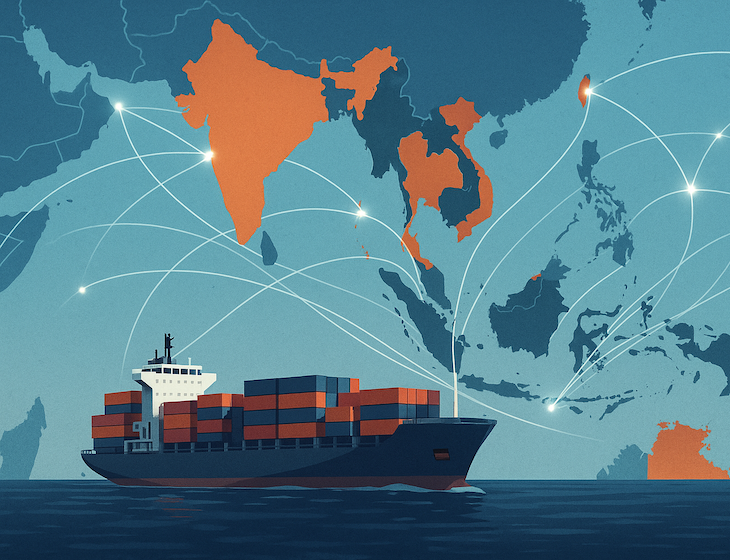
India, Vietnam and Indonesia each play a growing role in UK trade, but their agreements with the UK are at very different stages. This article looks at where each country stands and what the developing agreements could mean for PFE’s customers.
Following our overview of the UK’s wider trade agreement landscape, this update looks more closely at three key Indo-Pacific markets: India, Vietnam and Indonesia. Each country sits at a different stage of its trading relationship with the UK. India has recently signed a comprehensive free trade agreement, Vietnam already benefits from an active deal, while Indonesia does not yet have one in place. Together, these three markets offer an insight into how UK trade policy is evolving and what this may mean for PFE’s customers.
India
Status of the UK–India FTA
The UK and India signed their Comprehensive Economic and Trade Agreement (CETA) on 24 July 2025, after negotiations that began in early 2022. Although the agreement is formally in force, many of its tariff reductions and regulatory changes will be introduced gradually. Throughout 2025, the UK Government released technical notes and explanatory memoranda, making clear that businesses should pay close attention to implementation timelines rather than assume all benefits will apply immediately.
Changes to Products and Tariffs
Under the UK–India free trade agreement, a wide range of Indian-origin goods entering the UK will see reduced or phased-down tariffs over the coming years. For UK customers sourcing from India, the product areas expected to benefit include textiles and garments, leather goods, footwear and consumer electronics. The exact level and timing of tariff reductions will depend on the phased schedules set out in the agreement, and customers will still need to ensure that goods meet rules-of-origin requirements to qualify for preferential rates.
The agreement also contains commitments on business mobility and investment, although India has maintained protections for several sensitive domestic industries. Access in these areas will be phased in more cautiously.
As with all FTAs, businesses will need to ensure their goods meet the rules of origin and that the correct documentation is in place before tariff reductions apply.
Potential Impact
Government and independent analysis suggests that the UK-India deal could boost bilateral trade by up to £25.5 billion a year and may increase UK GDP by £4.8 billion over the long term. For businesses sourcing from India, the agreement may create new cost advantages and expand potential product categories for future procurement.
India’s scale and rapid economic growth mean the deal may open up new long-term opportunities as implementation phases roll out over several years. This is not a “switch on overnight” change; instead, it signals a significant realignment of trade relations between the UK and one of the world’s fastest-growing major economies.
Opportunities for PFE’s Customers
The new FTA provides a useful moment for customers working with Indian suppliers to review sourcing routes and logistics strategies. Reductions in tariffs, once phased in, may support lower landed costs or enable more competitive pricing. The agreement should also create clearer rules for customs clearance, which could improve delivery reliability.
PFE’s specialist customs teams will play an important role in helping customers meet rules of origin, manage documentation and plan routing strategies so that goods qualify for preferential treatment. Over time, businesses that align their procurement and customs planning with the new framework may find themselves better positioned to benefit from India’s expanding trade relationship with the UK.
Vietnam
Status of the UK–Vietnam FTA
The UK-Vietnam Free Trade Agreement (UKVFTA) has been in force since 1 January 2021, ensuring that preferential trade terms continued smoothly after the UK left the EU. The agreement largely mirrors the earlier EU-Vietnam deal but is tailored for UK–Vietnam trade. Alongside this bilateral agreement, the UK’s membership of the CPTPP (the Comprehensive and Progressive Agreement for Trans-Pacific Partnership, whose members are Australia, Brunei, Canada, Chile, Japan, Malaysia, Mexico, New Zealand, Peru, Singapore and Vietnam) adds another layer of alignment with Vietnam in the years ahead.
Changes to Products and Tariffs
The UKVFTA provides tariff reductions or eliminations across a wide range of product categories. For customers sourcing goods from Vietnam, key sectors benefitting from improved access include:
- footwear
- textiles and garments
- leather goods and bags
Many Vietnamese-made products gain competitive advantage through the preferential tariff schedule and clearer certification processes under the agreement.
As always, eligibility depends on meeting the rules of origin. Customers need to ensure that their Vietnamese suppliers provide the correct documentation and that the goods meet the required processing or local value thresholds.
Potential Impact
The agreement supports deeper integration between UK and Vietnamese supply-chains. Vietnam’s fast-growing economy and strong manufacturing base make it a valuable sourcing hub for a wide range of goods. The combination of tariff reductions, more predictable logistics and strengthened rules of origin may help businesses improve cost certainty and diversify their supply routes.
Opportunities for PFE’s Customers
For customers already sourcing from Vietnam, the UKVFTA presents opportunities to enhance competitiveness through lower duty costs and simpler customs requirements. Reviewing existing sourcing routes, checking qualification under the agreement and ensuring the right documentation is in place may help maximise the benefits.
As Vietnam continues to expand its manufacturing capacity, there may also be opportunities to diversify supply-chains, especially for businesses looking to spread geographic risk or move production to alternative hubs. PFE can support customers in assessing routing, certification and customs strategies to ensure goods qualify for preferential treatment.
Indonesia
Status of UK–Indonesia Trade Relations
Unlike India and Vietnam, the UK does not currently have a bilateral free trade agreement with Indonesia. The two countries are linked through a partnership roadmap focused on cooperation in investment, digital technology and wider economic development, but negotiations toward a full FTA have not yet been concluded. Indonesia has recently agreed a Comprehensive Economic Partnership Agreement (CEPA) with the European Union, signalling momentum in the region, although this does not extend to the UK.
Current Implications for Goods and Services
Because there is no UK–Indonesia FTA in place, trade continues under standard WTO rules and the UK’s general import policies. Indonesian-origin goods do not benefit from FTA-level tariff reductions or simplified customs procedures, and duty calculations must follow standard UK Global Tariff rules.
From January 2026, certain Indonesian products will also lose their preferential access under the UK’s Developing Countries Trading Scheme (DCTS) as some categories are graduated from the scheme. These goods will move to the full UK Global Tariff rate for a three-year period. More detail on this change is available in our separate article.
Potential Impact if a Deal Is Agreed
If the UK and Indonesia do complete an FTA in the future, the impact could be significant. Indonesia is the largest economy in Southeast Asia by population, with a growing manufacturing base. A future agreement could introduce tariff reductions, improved customs cooperation and more efficient documentation processes. This may open new sourcing opportunities and help diversify supply-chains beyond existing markets.
What PFE’s Customers Should Watch
For the moment, customers sourcing from Indonesia should note that:
- the UK does not offer preferential tariff treatment for Indonesian goods
- duty calculations and customs processes must follow standard UK rules
- any change will depend on progress in future negotiations
Businesses positioned to act early, by preparing documentation processes, reviewing supplier structures or assessing routing options, may gain an advantage if an agreement is eventually concluded.
Summary
India, Vietnam and Indonesia each sit at different stages of their trading relationship with the UK. India’s new FTA signals long-term opportunities that will unfold gradually. Vietnam already benefits from an active agreement supported further by CPTPP membership. Indonesia remains outside any UK trade agreement for now, but future developments may open new sourcing routes. PFE will continue to monitor progress across all three markets and keep customers updated as changes occur.
References:
GOV.UK – UK–India Trade Deal (Comprehensive Economic and Trade Agreement, signed 24 July 2025) GOV.UK
GOV.UK – UK trade agreements in effect (full list of active UK trade deals, including CPTPP accession) GOV.UK
GOV.UK – UK–Vietnam Free Trade Agreement (UKVFTA) page, including treaty documents and implementation information GOV.UK
GOV.UK – Summary guidance on UK–Vietnam trade and tariff arrangements under UKVFTA GOV.UK
Business.gov.uk – Export/import guidance for UK–Vietnam trade under UKVFTA and CPTPP Business Growth Service
GOV.UK / Official treaty documents – Impact assessment for the UK–India FTA (sectoral and business impact overview) GOV.UK Assets
GOV.UK – UK’s official collection of trade agreements including new deals post-Brexit GOV.UK